| ITS based on XML technology and web service |
- Future for ITS in Ubiquitous Network society -
We take in the concept of web service which is the next generation information technology system, suggest the construction of wider mobility supporting service (Smartway Web Service) and introduce how to develop the current RWML technology in order to make the service to reality. |
| ITS based on the web service |
 Internet is rapidly and widely popularized to the public by the commercial opening of the Internet in the USA in 1991 and the development of the Mosaic (browsing software) in 1993. Internet is rapidly and widely popularized to the public by the commercial opening of the Internet in the USA in 1991 and the development of the Mosaic (browsing software) in 1993.
HTML standardizes style of images, links and texts which are to be shown on the website and enable to express one's own site by combining the contents from other websites through linking function as if it is one's own information and to search things from websites all over the world as if one's own site is a huge database. On the other hand, XML standardize ways to define the structures and meaning of the data in order to universalize the information distribution on standardized platform called Web, and enables computers to read the meaning of the data. In short, it standardizes services on the web system and enables to offer new services of higher value by combining given services. We had 2000 people for the monitoring audience for Niseko-Yotei-Toya e-Route Experiment (2002) and 615 people for the Smart Sapporo Snow Information Experiment (2003), which, as a result, turned out to be relatively large field experiments. 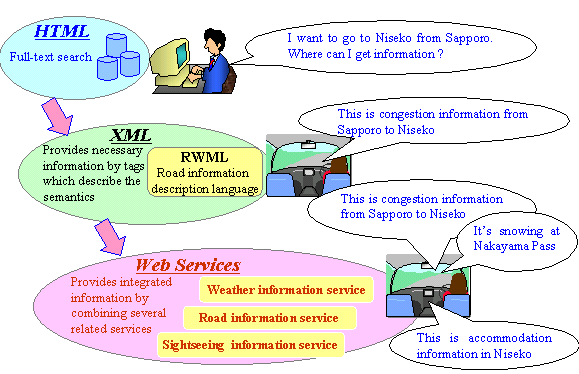
Figure: Flow from the use of HTML, XML to Web service
| Channel where RWML technology development goes. |
The current RWML describes local and road traffic information such as road surface condition, weather, sightseeing and local events regarding the relationship between the location of the roads and time. This can be taken advantage of, through the use of Internet, at every phase: collecting, exchanging, sharing, providing, sending, fabricating and trading information. Later phases form a more composite service. This kind of complicated service can be constructed easily if the concept of web service is adopted. If we are to call wider mobility supporting service Smartway Web Service, the need for Smartway Web Service-XML (SW-XML) is inevitable in order to support the construction of the system. However, we need to expand the current RWML, integrate XML data from other sources such as sightseeing, public transportation, weather and map information, and have functions to be able to offer information by combining web services based on each XML in this SW-XML. In the Internet field, we have various standardizing methods such as SOAP, WSDL and UDDI regarding defining the services, input and output, and procedures of combining, and it will be important for us to take advantage of using these technologies. SOAP is just like an envelope used in a post office: information needed to connect to use web services such as addresses are described on it. As well, WSDL is a body which standardizes the description of methods to use various services and so is just like users manuals. UDDI is a searching directory, consists of corporate information, performance information (yellow page), etc., and a web service offering body is to be registered on UDDI directory. 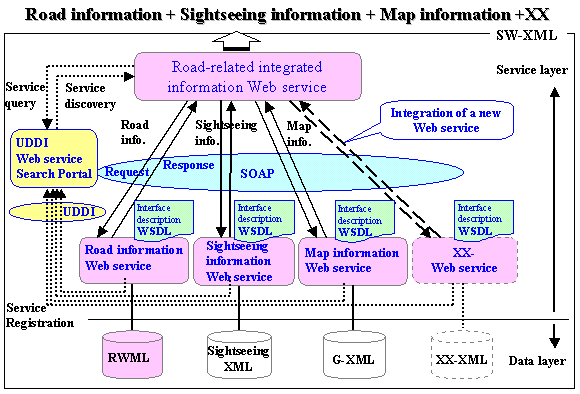
Figure: Channel where RWML technology development goes.
| Future for ITS in Ubiquitous Network society |
Ubiquitous Network Society is a society where a network goes throughout every hole and corner; all the devices such as home appliances and vehicles are connected to the network (reachable) and information is available any time and anywhere. We think mobile Internet technology such as Ipv6, enables us to realize this future society. ITS will gradually change regarding the realization of that society. ITS based on particular networks and devices will become an ITS based on multi-purpose network and devices. Road condition information is not the only piece of information needed in transit, but also information on public transportation, sightseeing and shopping. For users, it is important to have extensive information services and to offer suitable information needed by each user. We think ITS based on XML and Web service is going to be an essential technology as ITS itself grows as a business. Understanding this, we are aiming to develop and extend RWML technology.
|



